
When High Performance Isn’t Enough: Why Great Leaders Choose Impact Over Output
On shifting from optimizing yourself and your team for metrics to integrating who you are, how you lead, and the impact you actually create.
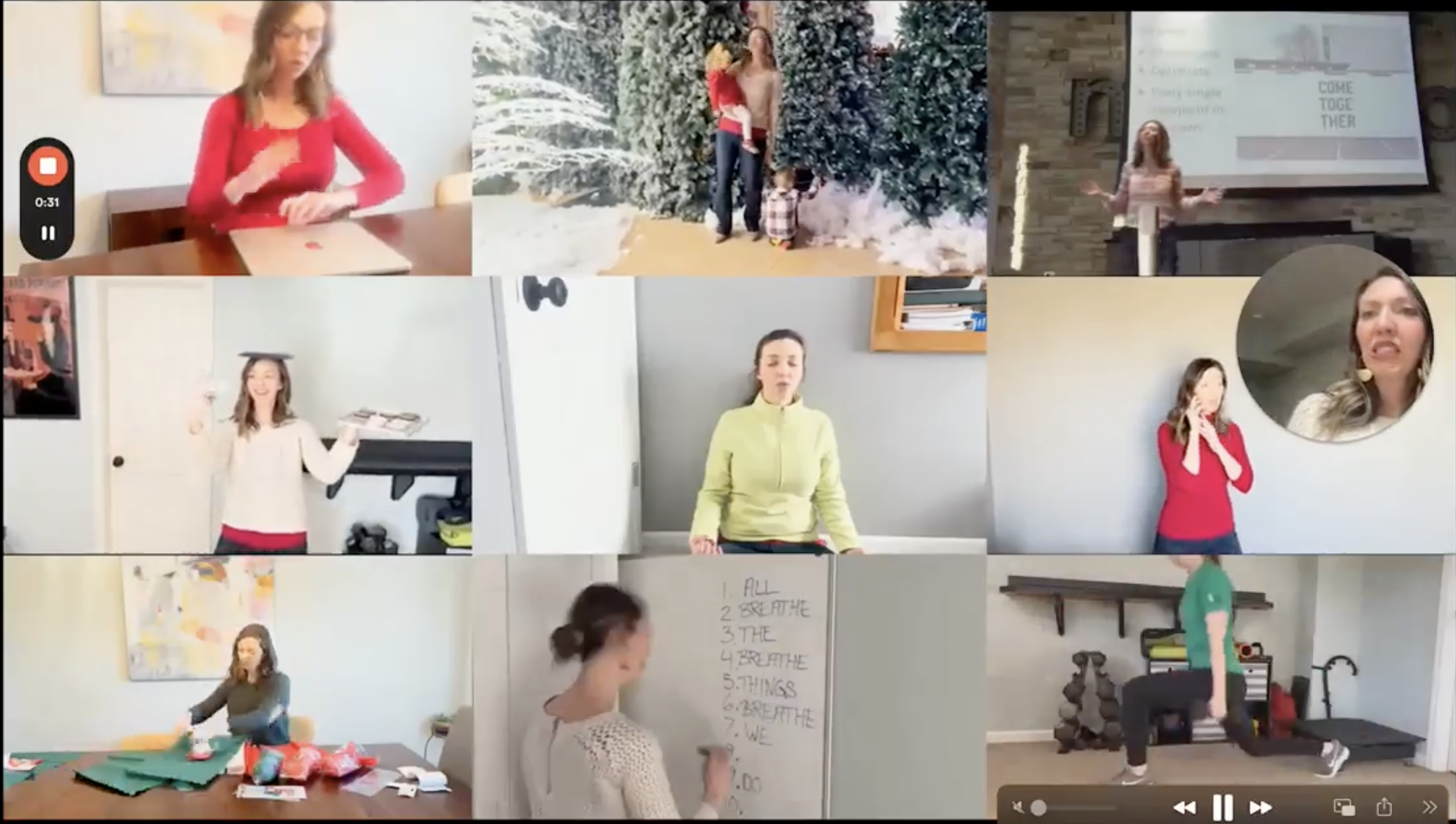
A few years ago, I made this ‘doing all the things’ holiday video as a joke. It turned out to be a pretty honest snapshot of my high‑performance era—and the exact mindset this essay starts to unravel.
For years, I wore “high performer” like a badge of honor.
I woke up before dawn, stacked habits with precision, and tracked everything: sleep metrics, macros, HRV, workouts, focus blocks, you name it. Every number felt like progress, every tweak a way to squeeze a little more potential from the day. At work, I was always knocking out the task list with high efficiency while scanning what was coming down the pike and collecting credentials as I did.
In my work with leaders and teams, I was already operating from a systems lens, connecting individual behavior change to the organizational shifts it was meant to fuel. I loved redesigning structures and reimagining culture across teams and functions. Exploring the optimized and quantified self, bringing that same mindset to my own biology, felt visceral. Here was a living system I could experiment with in real time. I was my own N of one. How much could I “optimize” this human system, my brain, my energy, my hours, for maximum performance? It was exhilarating to the point of near addiction.
The irony is that the systems I was steeped in highly reward this high‑performance addiction. How much more valuable can you be when you maximize every minute for efficiency and productivity? Organizations often treat efficiency, revenue, and easily tracked outputs as the primary markers of success, even when those metrics are misaligned with long‑term organizational health, culture, and strategy.
The wrong KPIs
What I eventually realized is that I wasn’t just tracking performance; I was confusing performance metrics with a meaningful life. I had quietly bought into the promise that if my HRV was dialed in, my sleep was “optimized,” I meditated daily (which only counted if it made it on my tracking app), and my calendar was perfectly orchestrated, I would somehow become a better human. I’d be more grounded, more fulfilled, more aligned, more connected.
But KPIs are just that: performance indicators. They can tell you whether you are moving faster, lifting heavier, answering more emails, counting dollars, or closing more projects. They cannot tell you whether you are living a life you actually want. They cannot tell you whether the direction you’re running is worthwhile and impactful.
Most of what makes a human life rich and meaningful is maddeningly resistant to clean measurement.
There is no tidy KPI for how present I feel when reading to my kids at night, for the quality of attention I bring to a tough conversation with a client, or for the depth of thought I give to ideas that may never directly convert into revenue but quietly shape how I want to create.
Eventually, the tools that gave me a sense of control started to feel like they were covertly in control of me. The more I measured, the more I saw myself as a project, as something to be monitored and fixed, rather than a human being to be lived from. I was performing beautifully, but I wasn’t necessarily leading myself or others toward what mattered most.
Optimization vs integration
That’s when the pendulum started to swing. Not in a dramatic, overnight way, but in a series of small, honest questions and nudges.
Optimization assumes you’re a machine to be tuned. Integration acknowledges you’re a living ecosystem to be tended.
In an optimized life, every input is evaluated against: Does this make me faster, better, more efficient? In an integrated life, the questions shift: Does this align with my values? Does this nourish the relationships and systems I’m accountable to? Does this help me grow in depth and capacity, not just in productivity?
There’s been a quieter shift for me: the convergence of contentment and growth. For a long time, growth was my proof that I was “on track.” It was one more way to justify my existence through progress. Now the question sounds different: Can I love a challenge and continuous improvement and still be deeply at peace with who and where I am today? Growth has moved from self‑improvement as self‑critique to growth as stewardship of this one body, this one life, this one chance to contribute.
These days, I’m less obsessed with the next hack and more drawn to the hidden, consistent work of intentional, engaged presence. I am designing and practicing leading behaviors, not just managing lagging metrics. Am I awake to what this season is asking of me? Can I tune in to the journey as it unfolds and to the gifts of learning and experience here? I must move beyond just the next upgraded version of myself I’m trying to earn.
When high performers hurt systems
This isn’t just an individual story. Organizations also confuse performance with impact all the time.
Most leaders can name at least one “high‑performing asshole” who rose quickly through the ranks. Their numbers look great. Their KPIs glow green. They hit targets, execute fast, and often get rewarded for it. But their wake is littered with burned‑out and run‑over colleagues, eroded trust, and a culture that insidiously adapts to their behavior. They are the last people who should be stewards of culture, direction, and complex critical thought, yet they’re often promoted because the metrics we track don’t include the health of the ecosystem they operate in.
We do the same thing with organizational interventions. Engagement is down, so we roll out bonuses, gift cards, or an ice cream social. We try to fix adaptive, complex, relational problems with technical, incentive‑based solutions. The dashboard looks better for a quarter, but the deeper issues of psychological safety, belonging, purpose, and real voice in decisions remain untouched. It is optimization logic applied to systems that actually require integration and redesign.
High performers are often exceptional at perfecting, repeating, and optimizing whatever system they’re handed. That’s useful, until the system itself is the problem.
Then the very traits that made them “top talent” can make them dangerous, because they reinforce what most needs to be questioned.
I notice this in how I parent, too. I don’t actually want to raise compliant children. Compliance can make life easier in the short term, undoubtedly, for parents, for classrooms, for whole school systems, because everyone stays in line and does what’s expected. But “just get in line” doesn’t grow the thoughtful, emotionally attuned, critically thinking citizens and leaders we actually need. We still expect respect, of course, but we practice the nuance of thoughtful questioning: why a rule exists, how someone else might see the situation, and what possibilities don’t exist yet but could. I want my kids, and the leaders I work with, to be the kind of people who can see the system, question it with care, imagine something better, and take iterative action to co-create it. I do not want humans to just perfect and repeat what’s already there.
High performance rewards precision, consistency, and speed, but it rarely invites us to ask why we’re running so fast, for whom, and for what purpose. And at what cost? To our ability to be present to our actual lives, to stay adaptive in a shifting context, and to wisely shape the systems we’re part of. It almost never asks whether that speed is truly serving our mission, deepening trust on our teams, or creating real value for our customers and stakeholders over the long term.
impact leadership as integration
Impact leadership demands different questions.
Instead of “How do we get more done?”, Impact Leaders ask:
Are we working on the right challenges?
Are we creating real change for the people, teams, and systems we touch, not just moving numbers on a dashboard?
Who benefits, and who might be left behind, if we keep running the current playbook?
Where are we chasing improvement from a sense of deficit, competing harder in a crowded, stale game? And where are we growing from a grounded sense of enough‑ness that frees us to create new value, new markets, and new ways of working?
Impact Leaders do the inner work first—and keep returning to it. We clarify values, spot patterns, and name our own assumptions and fears. That alignment becomes visible in the outer work. It’s how we show up with the people closest to us, in the cultures we help shape, and in the systems we are willing to question or redesign. Over time, we build the capacity to move fluidly between our own growth, our relationships, our organizations, and the wider legacy we hope to leave. Integration, in this sense, is inner work plus outer impact, brought into coherence across those spheres, over time, in public. It’s dynamic. It’s messy. It’s vulnerable and real.
This kind of leadership is not a hack. It’s a practice. It’s an ongoing integration. It asks less, “How do I control every input?” and more, “How do I keep returning to what really matters here, again and again, as an imperfect human among other humans?” In complex environments, the leaders who can navigate nuance, hold competing truths, and stay relationally grounded are the ones who actually move the needle in meaningful ways.
I’m not off meditating on a mountaintop or frolicking in a field contemplating my existence. I still deeply care about health, energy, and doing excellent work. And I, too, have bills to pay, emails to answer, dinners to figure out, and a company to steer. In fact, these commitments are part of what pulled me deeper into flow science and the realities of how humans perform and feel their best over time. But the metrics that matter most have changed. How grounded am I in conversations with clients and teams? How clearly are my actions aligned with what I say I value? When I help a leader or team see a blind spot, am I acting out of curiosity and care, or out of performance pressure and fear of falling behind?
This isn’t anti-performance. It’s re-humanized leadership—a way of working where excellence is powered by purpose and a better possible shared future, not isolated anxiety or unworthiness.
A reflection for the week
If you want to experiment with this, try this simple practice:
Look at your week ahead and scan it through two lenses: performance and impact. Where are you primarily focused on getting things done (tasks, meetings, metrics) without much attention to why they matter or who is affected?
Choose one meeting, one conversation, or one decision this week to slow down and reconnect to why it matters, who it affects (now and downstream), and how you want to show up in the process.
Ask yourself afterward: What changed in the experience when I approached this from integration rather than optimization? From presence rather than pressure? From designing moments instead of measuring minutes?
Over time, this is the real scoreboard: the learning moments we notice & what we do with them.
Not just “Did we perform?” but “What did we learn, and how did we let that learning reshape the way we show up, decide, and design our systems?”
The world does not need more people squeezing every last drop out of themselves in pursuit of an ever‑moving finish line. It needs more leaders willing to measure meaning as carefully as they measure output, and to keep integrating who they are with how they lead, in real time. We need more learning in the open and leading unmasked.